music songwriting
Songwriting in Nature: What the Research Suggests—and What It Does Not
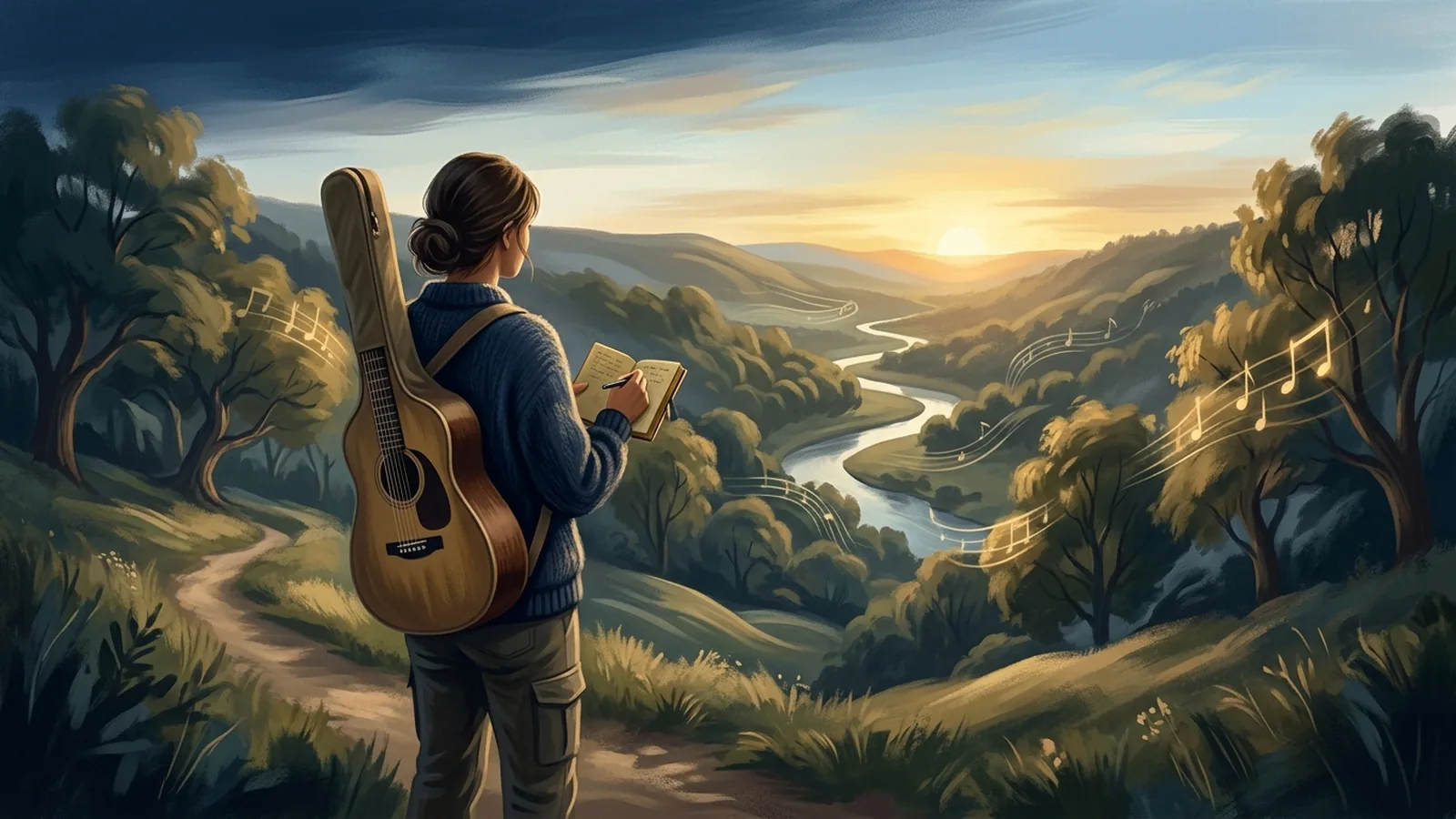
Writing music outdoors may support mood, creative reasoning and connection with nature. Yet the available research cannot show that nature alone causes these changes.
The link between songwriting in nature, wellbeing and creativity has an intuitive appeal. From a songwriter’s perspective, a change of landscape can feel like an invitation to notice different sounds, images and rhythms. That is a creative reflection, not a proven effect. Research into music-making in nature offers some encouraging observations, but it does not establish exactly what produced the reported changes.
That distinction matters to SWSD Music Production. As explored in Our Story, the project brings alternative rock, blues and ambient influences into cinematic production while engaging with mental health, recovery, relationships, resilience, identity and human connection. We value spaces that invite reflection, but we do not want to turn songwriting into a wellness promise or present a personal creative practice as medical evidence.
What did the review examine?
A scoping review of research combining music- and nature-based strategies considered interventions in which musical activity and engagement with nature appeared together. The work it summarised included songwriting in nature-based camps, classroom songwriting and other forms of musical engagement connected with natural settings or nature-focused education.
A scoping review maps an area of research rather than providing a single, final verdict. The underlying evidence covered varied settings, participants and combinations of activities, so direct comparisons and firm conclusions about cause are difficult. The central question is not simply whether participants reported changes after an activity, but whether those changes can be attributed to songwriting, the setting, education, the wider camp experience or some combination of these elements.
What the findings suggest
Changes in mood and stress were reported
Research covered by the review reported improved mood, reduced negative emotions and lower stress among participants in both nature-based camps and classroom settings. These are encouraging findings, but changes across more than one setting mean the evidence does not show that being in nature was solely responsible.
A cautious reading is that structured musical creativity may form part of a positive experience. Nature may also contribute something valuable, but the studies described in the review did not isolate its contribution with certainty.
Songwriting was associated with creative reasoning
Songwriting activities were associated with improved creative reasoning. The review also makes an important qualification: it was unclear whether the setting affected that improvement. The available evidence therefore does not establish that songwriting outdoors produces a stronger effect than songwriting elsewhere.
One possible creative interpretation is that songwriting can help a writer organise and connect ideas while shaping material into lyrics, melody or structure. The review did not test that mechanism directly. For musicians, the more grounded question may be whether a particular environment helps them notice, listen or write differently on a particular day—not whether nature is a guaranteed creativity tool.
Nature connection was another reported outcome
The review reports increased connection with nature, with camp participants showing greater nature connection than the control group. It also suggests that creating music in nature-based settings can offer a positive experience alongside closer engagement with the natural environment.
In creative terms, a songwriter might choose to work with details such as changing light, distance, texture, weather or silence. This is an artistic approach rather than a research finding: the setting can become part of the song’s language without becoming a promise about its effects.
What the research does not establish
The findings should not be stretched beyond the evidence. They do not demonstrate that songwriting in nature will improve everyone’s mood, reduce stress for every participant or produce better songs. Nor do they show that nature alone caused the reported outcomes.
- The songwriting and nature components were often part of broader educational or camp experiences.
- Some changes were also reported among classroom participants, making the role of the setting difficult to separate.
- The review associates songwriting with creative reasoning but states that the influence of the setting was unclear.
- The evidence base brings together varied interventions and settings rather than one uniform approach.
- Group-level findings cannot predict how any individual will respond to an outdoor environment.
- The evidence does not make songwriting a treatment or a substitute for professional mental-health support.
The most responsible conclusion is modest: combining musical creativity with nature may offer a positive experience, particularly around creative expression and connection with nature, but the limited and varied evidence does not justify stronger claims about cause or guaranteed outcomes.
A grounded way to explore outdoor songwriting
Songwriters can approach an outdoor setting as an artistic experiment rather than a prescribed wellbeing exercise, provided the place is safe and accessible for them.
- Spend a few minutes noticing specific sounds, colours, movement or changes in distance.
- Write down concrete images before trying to explain what they mean.
- Create a short lyric, rhythm or melodic phrase from one observation.
- Return to the material indoors and notice what changes during editing.
- Compare settings if that feels useful, without expecting one of them to produce a better mood or song.
A natural setting may open a creative door, or it may be distracting, inaccessible or simply wrong for the work at hand. Neither response needs to be treated as failure. Creative practice can remain flexible enough to respect the person, the place and the song.
Why this conversation belongs at SWSD
SWSD’s blend of alternative rock, blues, ambient influence and cinematic production is built around reflection and human connection. Questions about environment, attention and emotional honesty therefore belong naturally beside the music—not as claims of recovery, but as part of an open conversation about how songs take shape. That careful distinction also reflects the commitments set out in the Mental Health Pledge.
To continue exploring that reflective space through the music, listen to Through The Mist, Abstraction or State Of Mind. Each offers its own creative atmosphere without being presented as mental-health treatment or evidence of a universal outcome.
Sources
- pmc.ncbi.nlm.nih.gov Integrating music and nature: a scoping review of research on interventions involving both music- and nature-based strategies for mental health and wellbeing - PMC https://pmc.ncbi.nlm.nih.gov/articles/PMC12418201 · accessed 2026-08-17