mental health recovery
Songwriting vs Music Therapy: Why the Distinction Matters
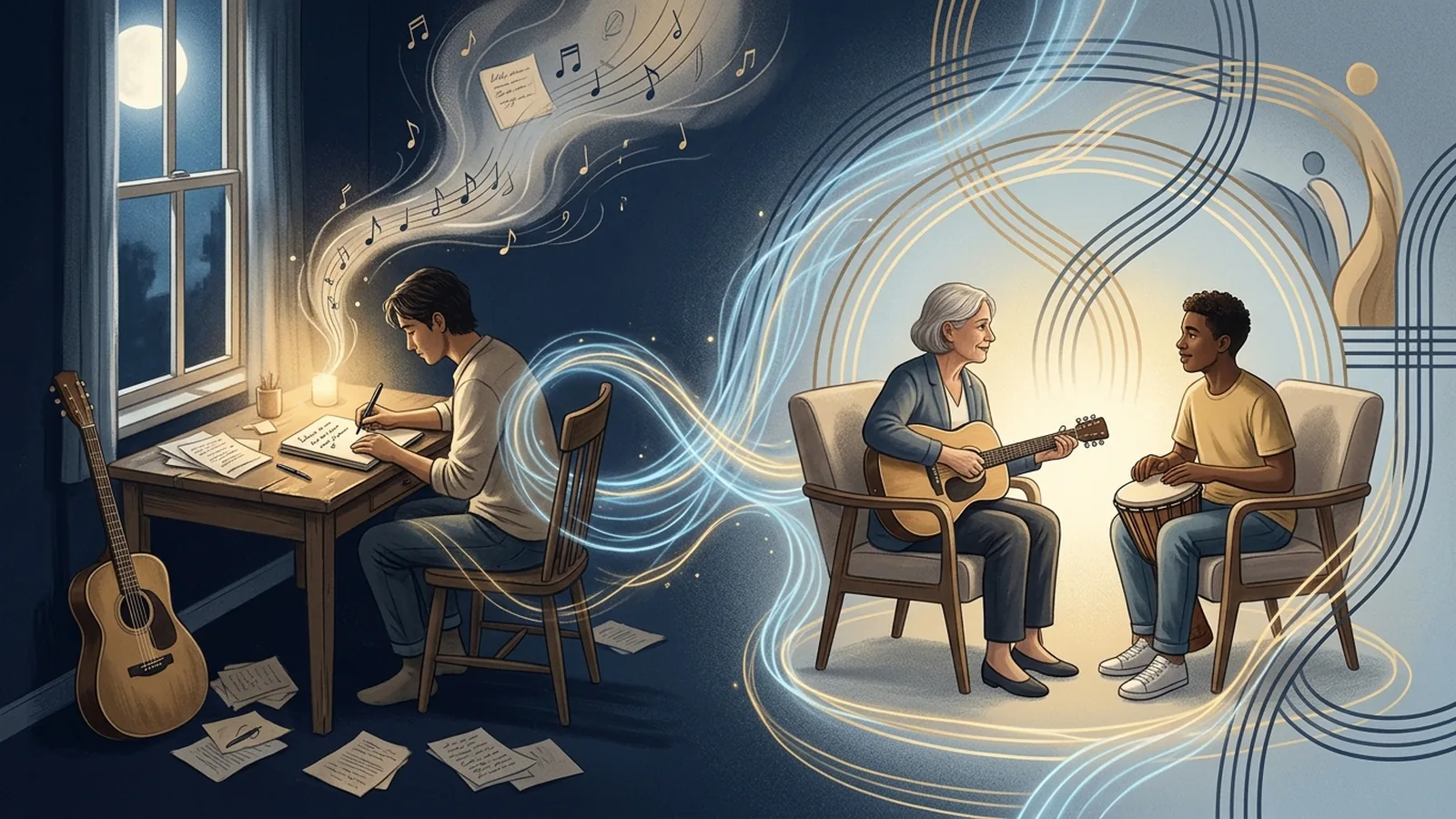
Songwriting can offer space for creativity, reflection and self-expression. Music therapy may use the same activity, but within a structured clinical relationship. Understanding that difference helps us value music without making unsupported treatment claims.
Songwriting can matter without being music therapy
A song can give shape to something difficult to say. Writing a lyric, finding a chord or following a melody may offer space for reflection, expression or creative enjoyment. For some people, songwriting becomes part of a personal self-care routine. Those possibilities can be meaningful, but the act of writing a song is not, by itself, music therapy.
The distinction is about more than the musical activity. A person might write privately, create with friends or collaborate on a recording. In music therapy, similar techniques may be used purposefully within an established professional therapeutic relationship. A University of North Dakota overview of music therapy describes it as a structured practice in which trained therapists use musical techniques to address individual needs and therapeutic goals.
The activity does not define the whole practice
Songwriting, lyric discussion, improvisation and listening can appear both inside and outside therapy. What changes is the surrounding purpose, relationship, planning and professional responsibility. A healthcare review available through PubMed Central distinguishes music therapy from non-clinical activities such as recreational listening or community singing, noting the role of structured evaluation, individual planning and therapeutic oversight in music therapy.
Professional titles, credentials and service arrangements can differ between countries. This article therefore does not try to define every regulatory system. Its narrower point is that making music independently should not be represented as equivalent to participating in a defined music therapy service.
The Indiana Center for Recovery offers one provider-specific example. At that centre, licensed therapists integrate activities including songwriting, lyric analysis, improvisation and listening into broader care. That description explains the centre’s own model; it should not be treated as a universal account of qualifications or practice in every jurisdiction.
A practical way to understand the difference
- Personal songwriting is a creative activity that someone may pursue alone or with others for expression, enjoyment, reflection or self-care.
- Songwriting in music therapy may use similar creative techniques within an identified therapeutic service, relationship and set of goals.
- The technique can overlap, but the context and professional responsibilities are not interchangeable.
- A creative experience can still hold value without being described as therapy or treatment.
Why careful language matters
Calling every emotionally powerful encounter with music “therapy” can blur an important boundary. It can also create expectations that a song, playlist or creative routine will produce a particular mental-health outcome. Individual experiences deserve to be heard, but they should not be turned into promises for someone else.
Careful language also protects the value of ordinary creativity. Personal songwriting does not need a clinical label to justify its place in a life. A lyric can hold uncertainty. A melody can mark a moment. A recording can connect people who recognise something of themselves in it. These are artistic and human possibilities, not medical claims.
What a research example can—and cannot—show
A Drexel University report about a cancer-survivorship study says researchers analysed 26 songs written during music therapy sessions. It also reports that participants discussed music-based strategies they could carry into daily life and a renewed appreciation of music and creativity as resources for self-care and wellness.
This is a report about a particular group of cancer survivors and should not be generalised beyond that context. It does not establish that independent songwriting recreates the sessions, provides equivalent support or addresses cancer-related distress. It shows how songwriting was used within the studied music therapy setting while some participants also valued music in everyday life.
Questions to ask when the language feels unclear
When an article, service or social-media post calls songwriting therapeutic, it can help to ask what the word means in that particular context:
- Is “therapeutic” being used informally to mean comforting, expressive or personally helpful?
- Is the activity part of an identified music therapy service?
- Is there an established professional therapeutic relationship, rather than only a prompt, application or recording tool?
- Are claims being made about treating a condition without enough evidence or context?
- Does the wording distinguish one person’s experience from an outcome that others should expect?
These questions do not diminish songwriting or music therapy. They help us describe each with greater honesty.
Why this distinction belongs at SWSD
SWSD Music Production brings alternative rock, blues and ambient influences into cinematic production, exploring mental health, recovery, relationships, resilience, identity and human connection. Tracks such as State Of Mind, Through The Mist and You’re Knot Listening belong within that creative landscape. Their engagement with mental-health themes does not make them medical care, and SWSD does not need to make that claim for the music to carry meaning.
This care with language also sits beside SWSD’s Mental Health Pledge. SWSD pledges 50% of net donations received through this website, after payment-processing fees and a statutory tax provision are deducted, to Mind in the UK and UNAFAM in France. The calculation and reporting approach are explained on the Pledge Transparency page.
Keeping the meaning without making a promise
Songwriting may offer a private page, a shared language or a way to create something from a difficult moment. Music therapy may use songwriting within a defined therapeutic process, but the two should not be treated as interchangeable.
Music does not have to be called therapy to carry meaning. Sometimes the most responsible way to honour a song is to let it remain what it is: an act of expression, connection and creation, without turning it into a clinical promise or presenting it as a replacement for professional care.
Sources
- treatmentindiana.com Impact Of Music Therapy On Mental Health - Indiana Center for Recovery https://www.treatmentindiana.com/resources/mental-health/impact-of-music-therapy-on-mental-health (2026-03-23) · accessed 2026-08-29
- drexel.edu Songwriting Survivorship: A Music Therapy Study Examines the Needs and Challenges of Cancer Survivors https://drexel.edu/news/archive/2026/August/Music-Therapy-Study-Examines-the-Needs-and-Challenges-of-Cancer-Survivors (2026-08-24) · accessed 2026-08-29
- University of North Dakota How Does Music Therapy Work? Benefits & Methods | University of North Dakota https://und.edu/blog/how-does-music-therapy-work.html (2026-06-04) · accessed 2026-09-19
- PubMed Central Music therapy in health care practice: promise, pitfalls, and policy implications https://pmc.ncbi.nlm.nih.gov/articles/PMC12968174 · accessed 2026-09-19